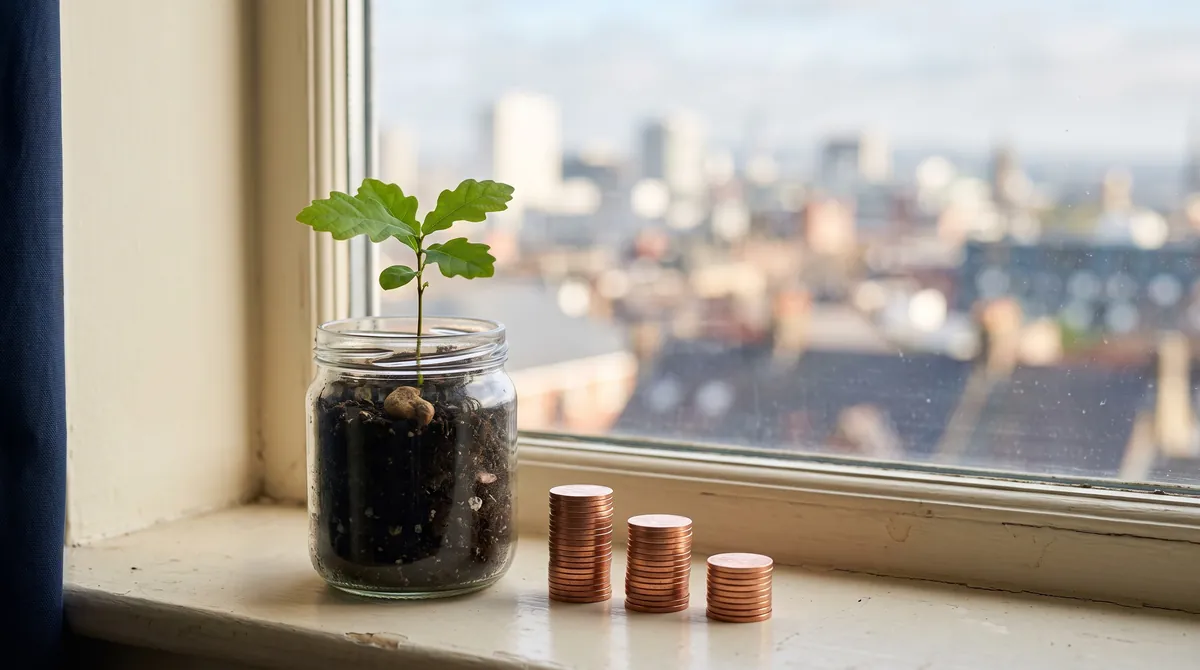
Why a higher income does not automatically create more freedom
Most of us expect the next pay rise to bring breathing room. Often it brings a bigger flat and a new car instead. Here is why, and what really moves you towards freedom.


The pay rise arrives, and for a few months it feels wonderful. Then, almost without noticing, the extra money finds a home: a nicer flat, a better car, more dinners out, another subscription. A year later your income is higher, your life is a little more comfortable and your account at the end of the month looks exactly as it did before. If that sounds familiar, you are in good company. It is one of the most common patterns in personal finance.
The good news is that the pattern is predictable, which means you can plan around it. To do that, it helps to understand why it happens.
The treadmill you cannot see
In 1971 the psychologists Philip Brickman and Donald Campbell coined the term hedonic treadmill in an essay on hedonic relativism and planning the good society. Their idea was simple and slightly unsettling: people adapt to improvements in their circumstances, so a gain that feels exciting at first soon becomes the new normal. You keep walking, but you stay roughly where you were.
Later research refined the picture. A 2006 review by Ed Diener, Richard Lucas and Christie Napa Scollon concluded that people do not simply return to a neutral point, that set points differ between individuals and that lasting change in happiness is possible. Adaptation is real, but it is not the whole story.
In money terms, adaptation shows up as lifestyle creep: spending that rises quietly with every raise until the raise has disappeared. No single decision feels extravagant. Together they lock in a higher cost of living.
So does more money make you happier?
For years, many articles quoted a neat answer. In 2010 Daniel Kahneman and Angus Deaton analysed more than 450,000 responses to a daily US survey. They found that people's evaluation of their lives kept rising with income, while day-to-day emotional wellbeing showed no further progress beyond about $75,000 a year.
In 2021 Matthew Killingsworth challenged that plateau. Using more than 1.7 million momentary reports from 33,391 employed US adults, collected through a smartphone app, he found that experienced wellbeing kept rising with income, with no sign of a plateau above $75,000.
Instead of trading rebuttals, the two sides tried something unusual. Kahneman and Killingsworth joined forces in an adversarial collaboration, with the psychologist Barbara Mellers as arbiter, and published a joint analysis in PNAS in 2023. Their conclusion: for most people, happiness keeps rising with income. A flattening does exist, but only in the least happy group, roughly the bottom 15 to 20 percent, where happiness rises up to about $100,000 a year and then levels off. For the happiest people the link even grows stronger above that level.
One detail matters for your decisions. In these studies happiness rises with the logarithm of income, which means each doubling brings a similar gain. Going from $50,000 to $100,000 counts about as much as going from $100,000 to $200,000. So every extra euro buys a little less wellbeing than the one before, while the fixed costs that often come with it can stay for years.
Fixed costs: the golden handcuffs
The real risk of a higher income is not the spending itself but the commitments it attracts. A larger mortgage, a car lease, private school fees, expensive memberships: these are fixed costs, and they are hard to reverse. Once they are in place, they set a floor under the income you need.
That floor is what people mean by golden handcuffs. The salary is generous, but the life built around it only works as long as the salary continues. Changing career, cutting hours or taking a break becomes frightening, not because you are poor but because your costs are high. Income has risen, and freedom has fallen.
A useful test: how many months could you cover your fixed costs from savings alone? If the answer has not improved in five years despite several raises, lifestyle creep has been winning.
The savings rate is the real freedom metric
If income is not the measure, what is? The most useful single number is your savings rate: the share of your net income that you keep and invest. It works twice. Every euro you do not spend can grow, and it also lowers the amount you will need later, because the life you are funding costs less.
| Savings rate | Years to reach 25 times annual spending |
|---|---|
| 10% | 57.7 |
| 20% | 40.3 |
| 30% | 30.2 |
| 40% | 23.0 |
| 50% | 17.4 |
| 60% | 12.8 |
Starting from zero savings. Savings paid in at the end of each month, monthly compounding at an expected real return of 4 percent a year divided by 12, target of 25 times annual spending (a 4 percent withdrawal rate), no fees, no tax, values in today's money. The result depends only on the savings rate, not on the size of the income. Illustrative only: real returns fluctuate and are never certain.
The table shows why the savings rate is a better guide than the salary. Moving from 10 to 20 percent shortens the time by about 17 years. Most of that comes from putting more money to work each month, and a further part from living on less, which shrinks the target itself. Time and growth do the rest, as explained in compound interest explained.
How to make every raise count
You do not need to live like a monk to change these numbers. The most effective approach is to decide what happens to money before it reaches your current account.
- Pay yourself first. Set up a standing order that moves your savings on payday, so you spend what is left instead of saving what is left.
- Split every raise. Decide in advance that a fixed share of each pay rise, for example half, goes to savings. Your lifestyle still improves, and your savings rate climbs too.
- Be careful with new fixed costs. Before you sign anything that runs for years, ask how it would feel to pay it on your previous salary.
- Spend deliberately on what you value. Cutting everything rarely lasts. Cut what you would not miss and keep what genuinely improves your days.
The idea of saving future raises has research behind it. In the Save More Tomorrow programme, designed by the economists Richard Thaler and Shlomo Benartzi, employees committed in advance to raising their retirement contributions with future pay rises. In the first implementation, published in 2004, 78 percent of those offered the plan joined, and their average savings rate rose from 3.5 percent to 13.6 percent over 40 months. Committing money you do not have yet turns out to be far easier than giving up money you already spend.
Freedom is a ratio, not a salary
None of this means a higher income is unimportant. More income gives you more room to save, and for most people it also brings more wellbeing. The point is that income only turns into freedom if part of it is protected from lifestyle creep. Two people on the same salary can be decades apart in how free they are.
Income only turns into freedom if part of it is protected from lifestyle creep.
It also helps to look at what your work really pays. Commuting, work clothes, the takeaway you order because you are too tired to cook: all of these reduce the true value of an hour at work. Seen that way, freedom is about time affluence as much as money. And if you have not yet decided what freedom would look like for you, start with what financial freedom means to you.
This article is general information, not personal financial advice. Returns are never certain, and the right choices depend on your situation.
trevisia provides general information, not personal financial, tax or legal advice. Figures are examples based on stated assumptions; returns are never guaranteed and rules differ by country. Please check your own situation with a qualified adviser.
Sources
- Hedonic treadmill, Wikipedia, accessed 2026
- High income improves evaluation of life but not emotional well-being, Kahneman and Deaton, PNAS, 2010
- Experienced well-being rises with income, even above $75,000 per year, Killingsworth, PNAS, 2021
- Income and emotional well-being: A conflict resolved, Killingsworth, Kahneman and Mellers, PNAS, 2023
- Save More Tomorrow: Using Behavioral Economics to Increase Employee Saving, Thaler and Benartzi, Journal of Political Economy, 2004