Habits beat willpower: building routines that last
Willpower is good at starting things and poor at keeping them going. Here is what habit research says about building routines that run almost by themselves.
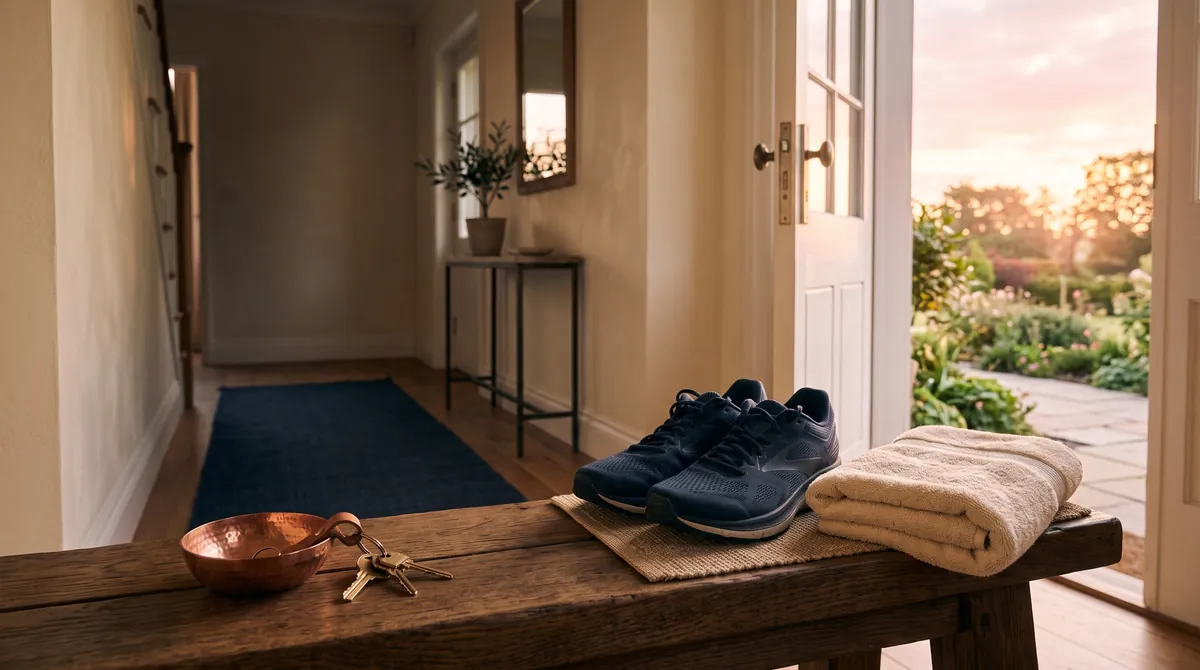

If you depend on willpower to go running at 6.30 in the morning, you hold a negotiation with yourself every day, and on some days you will lose. A habit ends the negotiation. The shoes are by the door, the route is familiar and you are outside before the debate begins. That is not a matter of character. It is how behaviour works for most people.
Why willpower is a weak foundation
It is tempting to think that successful people simply resist temptation better. Research suggests something else. In six studies with 2,274 participants, published in 2015, the psychologists Brian Galla and Angela Duckworth found that people with higher self-control reported using less effortful inhibition in daily life, not more. What linked their self-control to better outcomes, such as completing homework or keeping up a meditation practice, were beneficial habits.
Most of these studies were correlational and relied on self-reports, so they do not prove that habits cause success. But the pattern fits everyday experience: disciplined people often look disciplined because they have arranged their lives so that the right action needs little thought. Meanwhile, the popular idea that willpower is a tank that runs dry, known as ego depletion, is itself contested after a large 2016 replication found an effect close to zero.
How much of your day already runs on autopilot
Habits are behaviours that have been repeated so often in the same context that the context alone sets them off. In diary studies led by the psychologist Wendy Wood, including a 2002 paper with Jeffrey Quinn and Deborah Kashy, about 43 percent of the behaviours people recorded were ones they performed almost every day, usually in the same setting.
That share cuts both ways. It includes brushing your teeth and locking the door, but also checking your phone in bed or reaching for a snack at the same time every afternoon. Wood sets out the research for a general audience in her 2019 book Good Habits, Bad Habits. The practical consequence is simple: if so much of your day runs on cues, changing the cues often works better than trying harder.
How long it really takes
The popular claim that a habit takes 21 days has no solid basis. It is usually traced to Psycho-Cybernetics, a 1960 book by the plastic surgeon Maxwell Maltz, who wrote that people needed about 21 days to adjust to changes such as a new face. That is a long way from building a new routine.
The best-known real-world test came from a team at University College London. In a study published in the European Journal of Social Psychology in 2010, Phillippa Lally and colleagues asked 96 volunteers to choose an eating, drinking or activity behaviour and perform it daily in the same context, such as after breakfast, for 12 weeks. Data from 82 people could be analysed.
The time it took to reach 95 percent of a person's maximum automaticity ranged from 18 to 254 days, and the figure usually reported for a typical participant is 66 days. The upper end was a projection beyond the 84 days of the study, and only part of the group showed a clear curve. Exercise habits took longer than eating or drinking habits. And missing one opportunity did not materially affect the process.
Start tiny and anchor it
BJ Fogg, who directs the Behavior Design Lab at Stanford University, built a method around this insight. In his 2019 book Tiny Habits, he recommends attaching a very small version of the new behaviour to an existing routine, the anchor, and celebrating straight away so that the action feels good. The recipe follows a fixed pattern: after I do my anchor, I will do my tiny behaviour.
Tiny matters because it takes motivation out of the equation. Nobody needs willpower to floss one tooth or write one line. Once the behaviour runs automatically, it is far easier to let it grow.
| Anchor (after I ...) | Tiny behaviour (I will ...) | What it can grow into |
|---|---|---|
| Pour my morning coffee | Write one line in a notebook | Ten minutes of daily planning |
| Sit down on the train | Do one exercise in my language app | Twenty minutes of study |
| Close my laptop in the evening | Put my running shoes by the door | A regular morning run |
| See my salary arrive | Move €50 into savings | A standing order worth €600 a year |
| Brush my teeth at night | Floss one tooth | A full flossing routine |
Illustrative recipes. €50 a month for 12 months is €600, before any interest.
Design your surroundings, not your resolve
James Clear's Atomic Habits (2018) popularised the same idea under the name habit stacking, and Clear credits Fogg's anchoring for the concept: after a current habit, I will do a new habit. His broader framework asks you to make a good habit obvious, attractive, easy and satisfying, and to reverse each step for a habit you want to break.
In practice, environment design is the part most people skip. A few changes do more than any amount of resolve:
- Make the cue visible: the book on your pillow, the water bottle on your desk, the gym bag by the door.
- Add friction to unwanted habits: phone charger in the hallway, streaming apps logged out, snacks on a high shelf.
- Use defaults: an automatic transfer to savings on payday, a recurring calendar slot for exercise.
- Prepare the night before, so the morning version of you has nothing left to decide.
- Spend time with people for whom the habit is normal, so that it starts to feel normal for you too.
When you slip
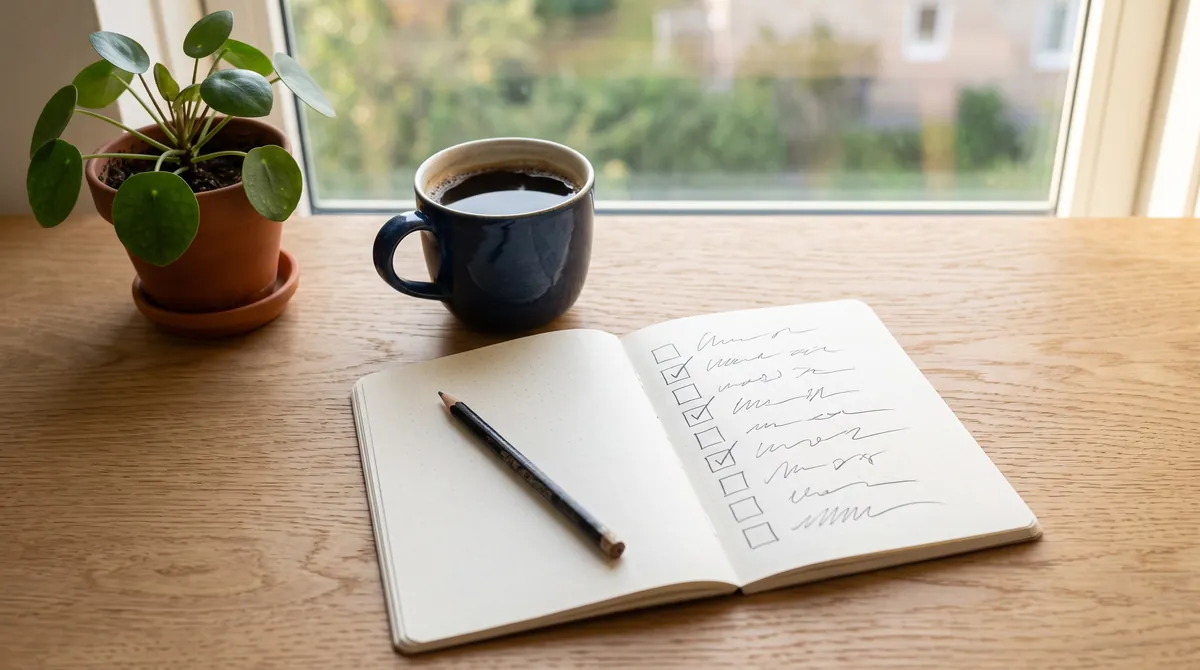
Everyone misses a day. Lally's data suggest that a single miss does not undo your progress, although frequent missed repetitions did lower the level of automaticity people reached. A helpful rule of thumb is never to miss twice in a row: the first miss is an accident, the second is the start of a new pattern. Tracking helps here: a row of ticks on paper is satisfying in itself, and it shows you at a glance whether a missed day was an exception or the beginning of a slide.
If a habit breaks down completely, look at the context before you blame your character. A new job, a move or a new baby changes the cues that held a routine in place. Rebuild the anchor first, then the behaviour.
Willpower starts a habit. Context keeps it going.
Habits are where goals become everyday life. If you have not yet decided what is worth repeating, begin with your own definition of success and turn it into goals that last. Because good habits save decisions, they also give you something back: time and attention for what matters most.
Sources
- How are habits formed: Modelling habit formation in the real world, Lally, van Jaarsveld, Potts and Wardle, European Journal of Social Psychology, 2010
- How to form a habit, BPS Research Digest, 2010
- Busting the 21 days habit formation myth, UCL Health Behaviour Research Centre blog, 2012
- More than resisting temptation: Beneficial habits mediate the relationship between self-control and positive life outcomes, Galla and Duckworth, 2015
- Creatures of habit: How habits shape who we are and who we become, NPR, 2019